
Best overall approach for Waukesha nursing homes in 2026: shortlist by CMS Care Compare overall rating, then confirm with the latest state inspection report and a tour. Best for short-term rehab: a skilled nursing facility with strong staffing and quality-measure ratings. Best for long-term care: a facility with stable staffing and a clean inspection history. Best for dementia: a facility with a dedicated memory care unit.
This guide covers how to choose among nursing homes in Waukesha County, WI, which care type fits which situation, and what to check before you sign anything. It is a decision guide, not a leaderboard of facility names, because ratings and inspection results change every few months.
TL;DR
- Start with CMS Care Compare, then read each Waukesha County facility's most recent inspection report before touring.
- Match the care type first: short-term rehab, long-term care, or memory care. They are different buys.
- Medicare covers skilled nursing for up to 100 days after a qualifying 3-day hospital stay, not long-term custodial care.
- Tour twice, once scheduled and once unannounced, and ask how often staffing changes.
Why this matters in 2026
Waukesha County is spread across a wide set of communities: Waukesha, Brookfield, New Berlin, Oconomowoc, Menomonee Falls, Pewaukee, Muskego, Mukwonago, Sussex, Hartland and Delafield. Families often search "waukesha nursing homes" and end up with a list of names and no way to rank them.
The cost of choosing wrong is high. A move between facilities is hard on a resident, and a rushed hospital discharge decision leaves you about 24 to 48 hours to pick. Build your shortlist before you need it.
Avina Healthcare publishes county-by-county senior care guides for Wisconsin. This one applies the same method to Waukesha County. For the broader picture of how the Avina Healthcare guides are organized, start on the homepage.
What makes the best nursing home in Waukesha County
Use these six criteria to audit any facility before you look at a ranking, including this one.
- Overall CMS star rating. Care Compare scores every Medicare- and Medicaid-certified nursing home from 1 to 5 stars. Treat 4 and 5 as a strong start, and 1 or 2 as a reason to dig deeper.
- Health inspection results. Read the most recent standard survey and any complaint investigations. Look for repeat citations in the same area, such as medication errors or pressure injuries.
- Staffing. Care Compare reports registered nurse hours and total nurse staffing per resident per day. Low or swinging numbers predict missed care.
- Quality measures. Falls with injury, pressure ulcers, and use of antipsychotic medication are all reported. Compare each to the state and national averages shown.
- Specialty fit. Rehab gym and therapy staff for short stays; a secured memory care unit for dementia; a bariatric or ventilator program if you need one.
- Distance from family. A facility visited three times a week beats a higher-rated one visited once a month. Visits are the best quality check there is.
Waukesha nursing homes at a glance: care types compared
The care type matters more than the building. This table shows which kind of Waukesha County facility fits which situation.
Short-term skilled nursing and rehab
- Best for: Recovery after a hospital stay, joint replacement, stroke
- Standout feature: Daily physical, occupational and speech therapy
- Key limitation: Medicare coverage is time-limited
Long-term nursing care
- Best for: Ongoing medical needs and help with daily living
- Standout feature: 24-hour nursing oversight
- Key limitation: Medicare does not pay for custodial care
Memory care unit
- Best for: Alzheimer's disease and other dementia
- Standout feature: Secured space, trained staff, structured routines
- Key limitation: Fewer facilities offer it; waitlists are common
Respite stay
- Best for: Family caregivers who need a break
- Standout feature: Short, defined stay
- Key limitation: Availability depends on open beds
Assisted living (adjacent option)
- Best for: People who need help but not skilled nursing
- Standout feature: More home-like setting
- Key limitation: Not for complex medical needs
1. Short-term skilled nursing: best Waukesha nursing home for rehab
Short-term rehab: this is the right fit when a hospital discharge planner says you need skilled nursing before going home. The goal is a return to independence, so therapy intensity matters more than room decor.
What it does: a skilled nursing facility provides licensed nursing and daily therapy. A typical stay follows a hospital admission for surgery, a fall, a stroke or an infection.
Short-term pros:
- Therapy is built into the day, usually physical, occupational and speech.
- Medicare Part A can cover the stay after a qualifying inpatient hospital stay of at least 3 days.
- Discharge planning to home is the explicit goal.
Short-term cons:
- Medicare covers days 1 to 20 in full and days 21 to 100 with a daily coinsurance. Coverage ends once you stop needing skilled care.
- Quality varies sharply between facilities, even within one town.
Coverage: Medicare Part A for qualifying stays, then Medicare Advantage or supplemental coverage depending on your plan. Call your plan before admission.
Best for: post-surgery and post-stroke recovery. Verdict: Buy, if the therapy staffing and rehab ratings hold up on Care Compare.
2. Long-term nursing care: best Waukesha nursing home for ongoing needs
Long-term care: this is the right fit when someone needs round-the-clock nursing and help with bathing, dressing, eating and mobility, and cannot safely stay home.
What it does: it provides a permanent residence with licensed nurses on site and care staff assisting with daily activities.
Long-term pros:
- Nursing oversight is constant, which matters for complex medication regimens.
- Residents get a stable care team, if the facility retains staff.
- Meals, activities and housekeeping are included in daily operations.
Long-term cons:
- Medicare does not pay for long-term custodial care. Families pay privately, use long-term care insurance, or qualify for Wisconsin Medicaid.
- Staff turnover is the number one quality risk. Ask about it directly.
Coverage: private pay, long-term care insurance, or Wisconsin Medicaid once eligible. An elder law attorney can explain asset rules before you spend down.
Best for: adults with multiple chronic conditions. Verdict: Buy, only after you read the last inspection report and tour twice.
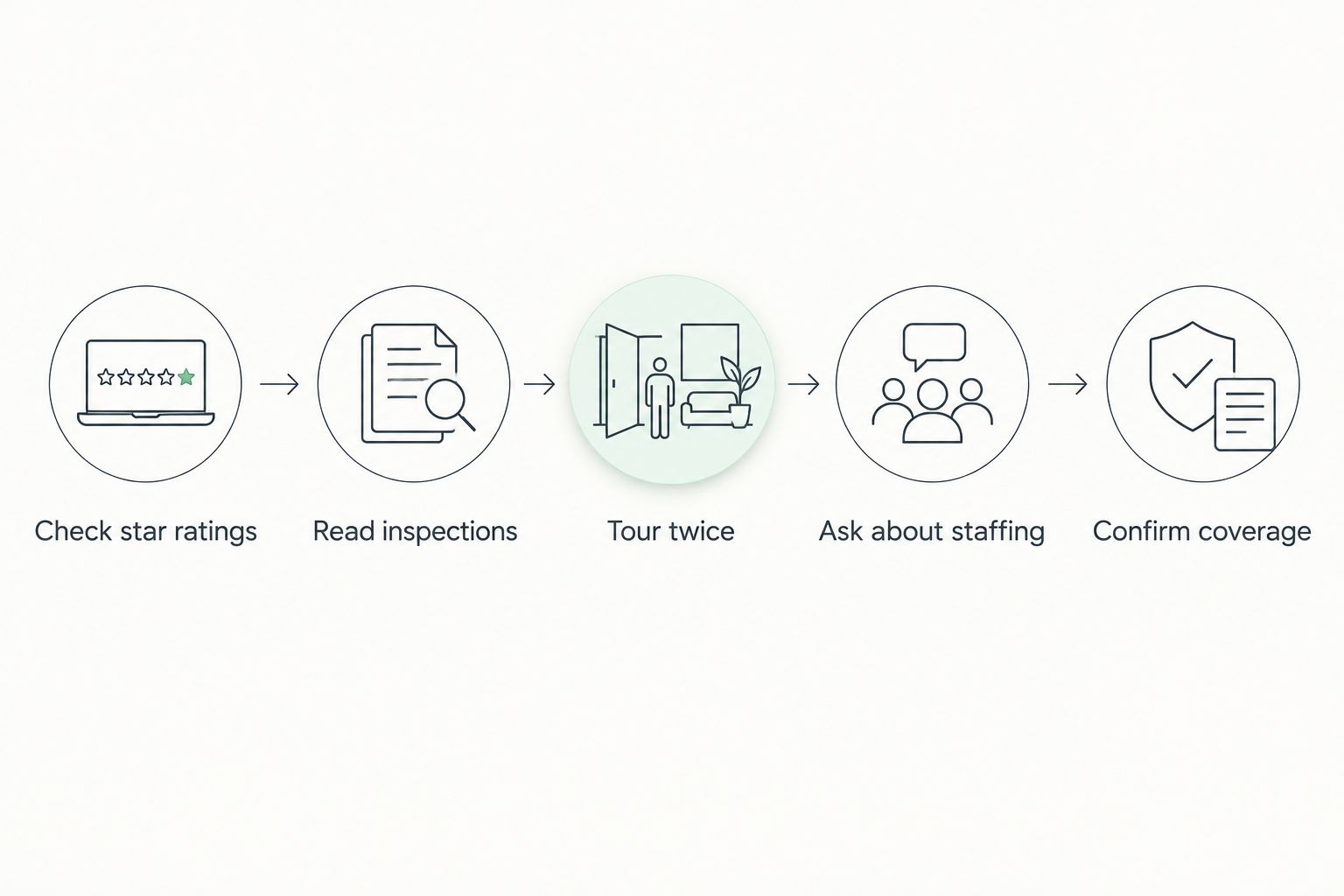
Ratings narrow the list. Inspection reports and tours decide it.
3. Memory care: best Waukesha nursing home for dementia
Memory care: this is the right fit when wandering, confusion or behavior changes make home care unsafe.
What it does: a dedicated unit has secured doors, a layout designed to reduce confusion, and staff trained in dementia communication.
Memory care pros:
- Secured space lowers the risk of wandering out of the building.
- Predictable routines reduce agitation for many residents.
- Staff training in dementia is the main differentiator, so ask for specifics.
Memory care cons:
- Not every nursing home has a true memory unit, and some only label a wing.
- Antipsychotic medication use is a known risk area. Check that quality measure on Care Compare.
Coverage: same as long-term care: private pay, long-term care insurance or Medicaid.
Best for: moderate to advanced dementia. Verdict: Buy, if the unit is real and the antipsychotic use rate is at or below average.
4. Respite stays: best option for family caregivers
Respite: this fits when a family caregiver needs a week or two away for travel, surgery or rest.
What it does: a short, planned stay in a nursing home that accepts respite admissions.
Respite pros:
- It lets you test a facility before committing to a long-term move.
- It protects the caregiver from burnout.
Respite cons:
- Bed availability is unpredictable and most facilities prioritize longer stays.
- Payment is typically private unless a program applies.
Best for: caregivers testing the waters. Verdict: Hold, until you confirm availability and payment in writing.
5. Assisted living: the adjacent option to rule in or out
Assisted living: if the person needs help with daily tasks but not skilled nursing, assisted living costs less in effort and often feels more like home. It is the wrong choice when care needs are medical and constant.
Assisted living pros: private apartments, social dining, lighter supervision.
Assisted living cons: limited nursing, and a move to a nursing home may follow if needs rise.
Best for: independent seniors who need support. Verdict: Wait, unless a physician confirms skilled nursing is not required. Compare the Wisconsin options in the assisted living guide for Milwaukee.
Start your senior care search
Browse Avina Healthcare's Wisconsin senior care guides.
How to rank a specific Waukesha facility in 15 minutes
This is the method behind every pick above. Run it on any facility you are considering.
- Search by ZIP code on Medicare's Care Compare. Enter a Waukesha County ZIP and filter to nursing homes.
- Sort by overall rating, then open the top five. Note health inspection, staffing and quality measure stars separately.
- Read the inspection narrative. Citations tagged as actual harm or immediate jeopardy are red flags. Surveys happen roughly every 12 months and no more than 15 months apart on average.
- Check for a Special Focus Facility flag. CMS uses it for facilities with a pattern of serious quality problems.
- Call the Wisconsin Long-Term Care Ombudsman Program. It is a free advocate service and can tell you what complaints look like in your area.
- Tour twice. Visit once with an appointment and once at a mealtime or weekend without one.
What to ask on a tour
- How many residents does each aide care for on the evening shift?
- How long has the director of nursing been in the role?
- What percentage of nursing staff are agency or temporary?
- How are falls, wounds and weight loss tracked and reported to families?
- What happens if the resident's care needs change or Medicare coverage ends?
The answers matter less than how quickly and openly staff give them.
How we ranked
This page ranks care types, not named buildings, using the six criteria above: star rating, inspections, staffing, quality measures, specialty fit and distance. Avina Healthcare does not rank individual Waukesha County facilities here because Care Compare data updates on a rolling schedule and a static list goes stale. Check the live data for each name on your shortlist.
Which Waukesha nursing home type should you choose?
- Recovering from surgery, stroke or a fall? Choose short-term skilled nursing and rehab.
- Needs 24-hour care for the long haul? Choose long-term nursing care.
- Living with dementia? Choose a facility with a real memory care unit.
- Unsure? Ask the hospital discharge planner or your physician for a level-of-care recommendation, then run the 15-minute method.
The default for most families: shortlist three Waukesha nursing homes with 4 or more overall stars, read their inspections, and tour all three.
FAQ
How do I find the best nursing homes in Waukesha County?
Search Waukesha County ZIP codes on Medicare's Care Compare and sort by overall star rating. Then read each facility's latest inspection report and tour before deciding.
Does Medicare pay for nursing homes in Waukesha?
Medicare pays for skilled nursing and rehab for up to 100 days per benefit period after a qualifying 3-day inpatient hospital stay. It does not pay for long-term custodial care.
How does Medicare coverage work after day 20?
Medicare covers days 1 to 20 in full and days 21 to 100 with a daily coinsurance. Coverage ends earlier if you no longer need skilled care.
What is the difference between a nursing home and assisted living?
A nursing home provides 24-hour licensed nursing and medical care. Assisted living helps with daily tasks in a more residential setting and has limited nursing.
How can I check a Waukesha nursing home for complaints?
Review its inspection and complaint history on Care Compare and contact the Wisconsin Long-Term Care Ombudsman Program. Both are free.
How many stars should a good nursing home have?
Look for 4 or 5 overall stars as a starting point. Then check the staffing and health inspection stars individually, since the overall score can mask a weak area.
How do people pay for long-term nursing home care in Wisconsin?
Most pay privately, use long-term care insurance, or qualify for Wisconsin Medicaid after meeting financial limits. An elder law attorney can explain the rules.
One last thing
The single most predictive question on a tour is: how long have your nursing and care staff worked here? Facilities that keep staff for years tend to catch problems early. Ask it at every stop in 2026, and weigh the answer above the lobby.
